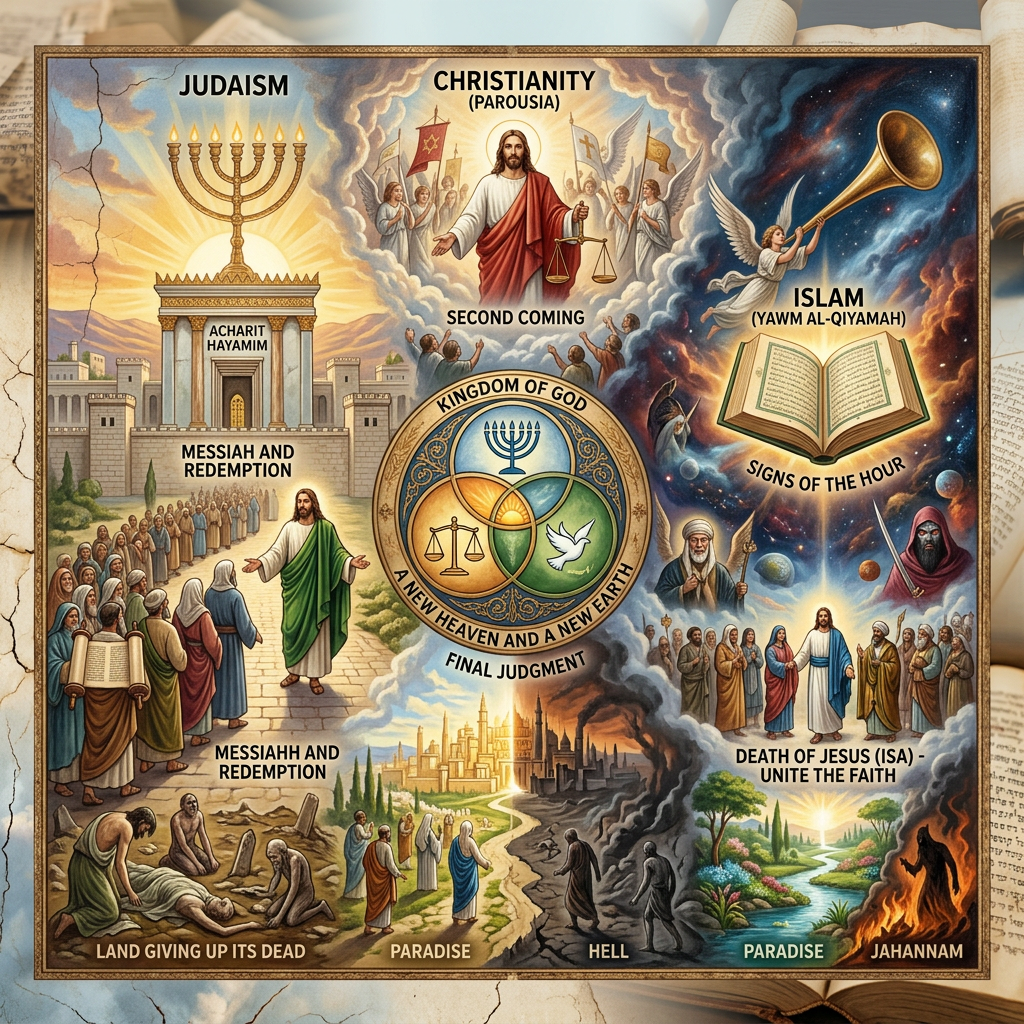
The concept of replacement theology, or supersessionism, is traditionally studied within Christian regularities to describe the belief that the Christian Church has succeeded and replaced Israel as the true chosen people of God. In the comparative study of Abrahamic religions, however, Islam introduces a comprehensive paradigm of supersessionism. This Islamic iteration operates not merely as a historical transition of divine favor, but as a total structural, historical, and cosmic replacement. Within this paradigm, the Muslim people/nation (the Ummah) does not emerge as a separate offshoot of Abrahamic monotheism; instead, it is positioned as the sole, uncorrupted heir to the original covenant.
This theological dynamic reaches its logical conclusion across three interconnected layers: the retroactive revision of the prophetic lineage, the textual cancellation of prior revelations, and a literal eschatological substitution on the Day of Judgment (Yom al-Akher).
I. Prophetic Revisionism and Cosmic Primacy:
Unlike Christian supersessionism, which views the history of Israel as a necessary, authentic precursor fulfilled through Jesus Christ (Yeshuah), Islamic theology establishes itself through a retroactive re-evaluation of history. In the Islamic framework, the prophets of the Hebrew Bible and the Christian New Testament, including Adam, Abraham, Moses, David, and Jesus, were never part of distinct religious traditions called Judaism or Christianity. Rather, they are structurally recast as Muslim figures who submitted entirely to Allah (the deity of Islam) and preached the foundational tenets of Islam. Abraham is explicitly designated in the Quran not as a Jew or a Christian, but as a primordial monotheist (a Hanif) and a Muslim. Consequently, the historical lineage of Israel is stripped of its exclusive spiritual heritage; the prophets belonged to the line of Islamic submission, making the Muslim Ummah (nation) the only rightful beneficiary of their memory and authority.
II. Textual Supersessionism and the Doctrine of Tahrif:
To sustain this historical reclamation, Islamic theology utilizes the doctrine of scriptural corruption, or tahrif. According to this doctrine, the revelations originally delivered to previous communities—specifically the Torah given to Moses (the Tawrat) and the Gospel given to Jesus (the Injil)—were genuine Islamic revelations.
However, classical Islamic discourse claims that Jewish and Christian scribes altered, excised, or distorted these texts over time, thereby obscuring references to the future coming of Muhammad and compromising pure monotheism. The revelation of the Quran is therefore understood not as a supplement to existing scriptures, but as a
final, uncorrupted correction that completely supersedes and invalidates them. By asserting that previous scriptures are compromised, the theological legitimacy of Jewish and Christian communities as distinct covenantal entities is effectively dissolved.
III. Eschatological Substitution: The Ransom
The final and most severe manifestation of Islamic replacement theology extends past temporal history and projects into the afterlife. In mainstream Islamic eschatology, the ultimate fates of the righteous and the wicked are intertwined through a cosmic transaction known as ‘al-Fida’ (the spiritual ransom). According to canonical Sunni traditions, every human soul has an allocated seat in both Paradise and Hell. On the Day of Judgment, sinful Muslims who are technically deserving of hellfire due to their transgressions are granted a divine amnesty. This pardon is actualized by transferring their impending punishment to a non-Muslim surrogate, specifically a Jew or a Christian, who is cast into Hell in place of the Muslim.
This doctrine is explicitly codified in Sahih Muslim, one of the two highest authorities in Sunni Hadith literature, within the Book of Repentance (Kitab al-Tawbah). Abu Musa al-Ash’ari transmitted that the Prophet Muhammad declared:
“No Muslim would die but Allah would admit in his stead a Jew or a Christian in Hell-Fire.” (Sahih Muslim, Book 37, Hadith 6666)
A secondary transmission reinforces this cosmic substitution, explicitly addressing the transfer of moral and spiritual debt to Jews and Christians:
“There would come people amongst the Muslims on the Day of Resurrection with sins as heavy as a mountain, and Allah would forgive them and He would place in their stead the Jews and the Christians.”
(Sahih Muslim, Book 37, Hadith 6668).
Furthermore, some Islamic commentators, such as the medieval scholar Imam Al–Nawawi, sought to reconcile these traditions with the Quranic dictate that “no bearer of burdens shall bear the burden of another” (Surah 35:18). Al Nawawi explained that this substitution does not mean individuals are punished arbitrarily for sins they did not commit. Instead, it relies on the concept of pre-allocated spaces: when non-Muslims are condemned to Hell due to their foundational rejection of Islam, they effectively occupy the physical vacancies left behind by saved Muslims.
Thus, their placement in Hell serves as a contextual “ransom” that spares the sinful believer.
Conclusion
Islamic replacement theology operates as an all-encompassing ideological loop. It begins in antiquity by absorbing the identities of biblical prophets, functions in the temporal world by invalidating Jewish and Christian scriptures, and culminates in eternity on the Day of Judgment. By substituting the Jew or Christian for the sinful
Muslim at the end of days, Islamic eschatology literalizes the earthly concept of supersessionism into a cosmic reality, sealing the definitive triumph of the Ummah over its religious predecessors.
Bibliography
Al-Nawawi, Abu Zakariya Yahya ibn Sharaf. Al-Minhaj bi Sharh Sahih Muslim ibn al-Hajjaj [The Commentary on Sahih Muslim]. Beirut: Dar Ihya al-Turath al-Arabi, 1972.
Al-Tabari, Abu Ja’far Muhammad ibn Jarir. Jami’ al-bayan ‘an ta’wil ay al-Qur’an [The Commentary on the Quran]. Cairo: Dar al-Ma’arif, 1954.
Lazarus-Yafeh, Hava. Intertwined Worlds: Medieval Islam and Bible Criticism. Princeton: Princeton University Press, 1992.
Muslim ibn al-Hajjaj al-Qushayri. Sahih Muslim. Translated by Abdul Hamid Siddiqui. Riyadh: Darussalam Publishers, 2007.
Netton, Ian Richard. Islam, Christianity and Judaism: A Crossroads of Prayers and Presence. London: Routledge, 2012.

